
Can FSR 4.1 transform Xbox graphics? Discover how AMD’s new AI upscaling works and why the Xbox Series S could face a real performance challenge.
Xbox Series X/S and FSR 4.1: How AMD’s AI Upscaling Could Change Console Gaming
If you play on console regularly, you’ve probably started noticing it already. Many of this generation’s biggest and most visually ambitious games are beginning to look surprisingly blurry despite the massive hardware leap promised by Xbox Series X and Series S. Games like Pragmata and Resident Evil Requiem push far more advanced lighting, denser environments, and significantly heavier graphics workloads, but there’s an obvious tradeoff: image clarity is taking a hit.
The issue becomes especially noticeable in motion. Unstable edges, smeared fine detail, and an overall soft-looking image that doesn’t always feel particularly “next-gen.” In some cases, certain games even bring back memories of the PS3 and Xbox 360 era, when aggressive blur filters were often used to hide technical limitations.
And no, this isn’t just a case of poor optimization.
The reality is that current-gen consoles are starting to hit their limits when trying to run modern AAA games at stable 60 FPS without making aggressive compromises elsewhere. To maintain performance, many engines are dropping internal rendering resolutions to 720p or even lower during heavier scenes. That’s where AMD’s latest bet comes into play: FSR 4.1.
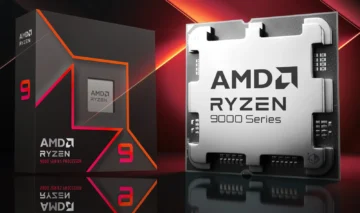
AMD has officially introduced a new generation of its upscaling technology, but this time the change is much bigger than a normal version upgrade. For the first time, FSR moves away from purely algorithmic reconstruction and embraces AI and machine learning, bringing it much closer to what Nvidia has been doing with DLSS for years. More importantly, AMD has already confirmed support for older architectures.
That immediately raises the big question: could this technology eventually come to Xbox Series X and Xbox Series S? And more importantly, do these consoles actually have the hardware needed to run AI-based image reconstruction effectively?
Let’s break down how FSR 4.1 works and why its arrival on consoles suddenly feels far more realistic than it did just a few months ago.
What Is FSR 4.1 and Why Does It Matter?
To understand why FSR 4.1 is generating so much attention, we first need to look at the limitations of current upscaling technologies. Up until now, FSR 2 and FSR 3.1 have been AMD’s main tools for maintaining acceptable image quality on both consoles and PCs without dramatically increasing performance costs.
These technologies rely on traditional algorithms and temporal reconstruction. In simple terms, the system takes a low-resolution rendered image, analyzes motion vectors and previous frames, and attempts to rebuild a higher-resolution output using predefined mathematical formulas.
When the base resolution is still reasonably high, for example reconstructing from 1440p to 4K, the results can look surprisingly good. The problem starts when developers are forced to aggressively lower internal resolution to keep performance stable. In extremely demanding games, some consoles are now rendering below 720p during heavy scenes, and that’s where traditional reconstruction methods begin to fall apart.
The lack of source image information creates familiar visual artifacts: ghosting, shimmering, unstable fine detail, and a generally softer image. The algorithm simply doesn’t have enough real data to accurately reconstruct complex elements like hair, foliage, cables, or detailed textures.
That’s where FSR 4.1 fundamentally changes the approach.
With this new version, AMD introduces machine learning models and neural networks trained using AI. Instead of relying entirely on fixed rules written by engineers, the system uses models trained on massive datasets of high-quality images to learn how certain visual patterns should look.
In practice, this means FSR 4.1 doesn’t simply “stretch” a low-resolution image. The AI attempts to intelligently reconstruct missing detail based on prior training data. The expected result is a cleaner, sharper, and far more stable image, especially in scenarios where FSR 2 or FSR 3.1 tend to break down visually.
It’s essentially the same conceptual leap Nvidia made when it introduced DLSS.
AMD’s Unexpected Shift: FSR 4.1 Will No Longer Be Exclusive to RDNA 4
Originally, AMD had much more restrictive plans for FSR 4. The company intended to position the technology as one of the flagship features of its future RDNA 4 GPUs, following the standard industry strategy: lock the most advanced features behind new hardware to drive upgrades.
But the situation eventually changed quite dramatically.
According to a recent report from the tech-focused channel Moore’s Law Is Dead, AMD faced heavy pressure both from the community and from several major players in the gaming industry. The original exclusivity announcement was poorly received, especially among RX 6000 and RX 7000 users who expected at least partial compatibility with AMD’s AI features.
The backlash became particularly intense across forums and social media, to the point where AMD reportedly limited comments on some promotional FSR 4 content.
However, community reaction wasn’t the company’s only problem. There was an even bigger issue behind the scenes: actual developer adoption.
With the rise of handheld gaming PCs and rumors surrounding future Steam Machine-like devices built on older AMD hardware, launching an AI technology limited to a tiny install base risked becoming a serious problem. Many studios simply weren’t willing to spend time and money integrating a feature that only a small percentage of users could actually enable.
In the end, AMD needed the exact opposite: a massive hardware install base large enough to justify widespread FSR 4.1 adoption inside modern game engines.
That’s why the company eventually changed course and confirmed that FSR 4.1 would also support RX 7000 GPUs based on RDNA 3, as well as RX 6000 cards built on RDNA 2.
And that’s where things suddenly become very interesting for Xbox.
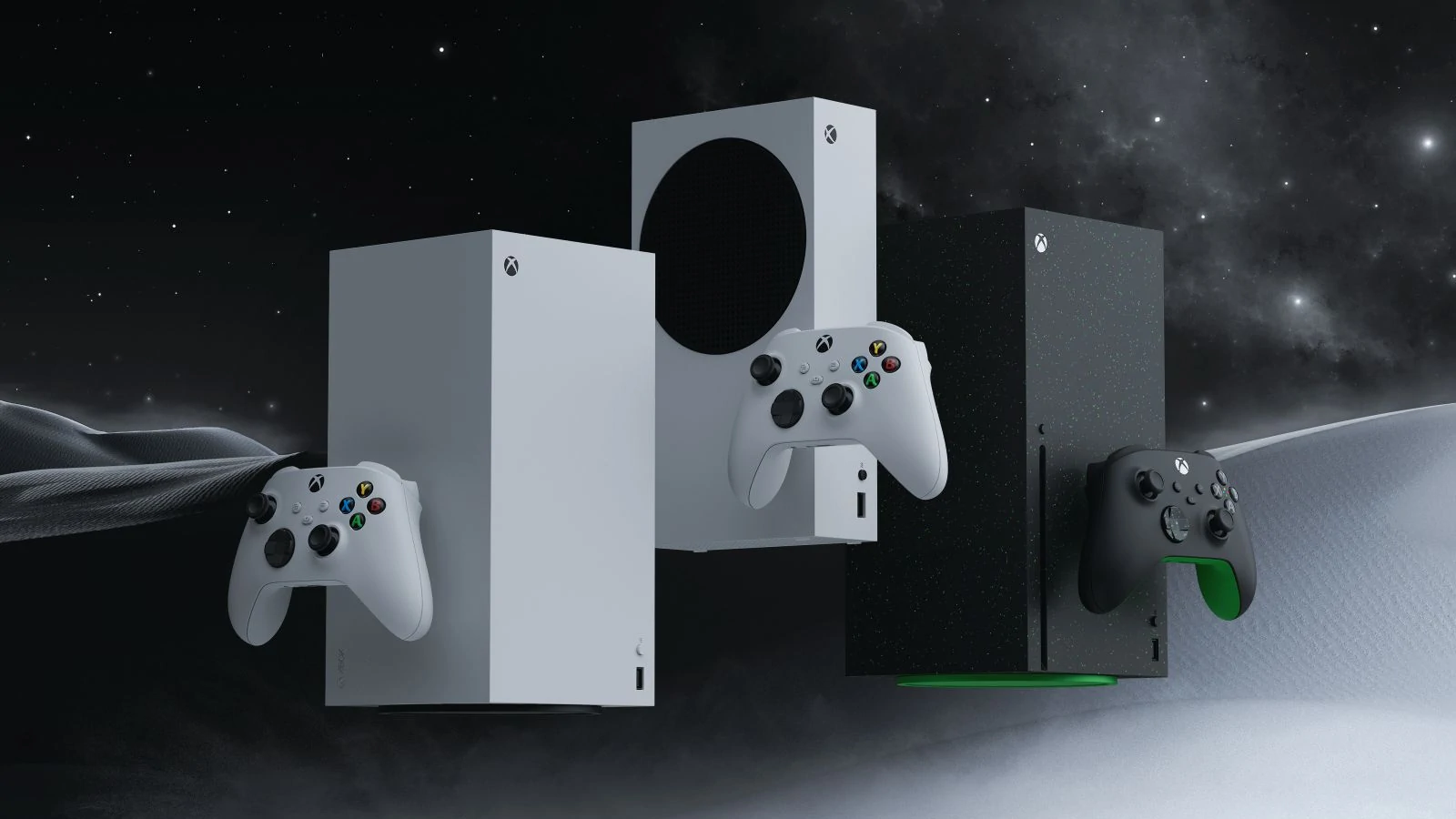
Both Xbox Series X and Xbox Series S use hardware based on RDNA 2. That means, at least on paper, Microsoft’s consoles share part of the underlying architecture needed to run this new generation of AI-based upscaling.
RDNA 3 vs RDNA 2: The Key Difference That Could Define FSR 4.1 on Xbox
To understand the real challenge behind bringing FSR 4.1 to consoles, we first need to look at the architectural differences between RDNA 2 and RDNA 3. On paper, the two architectures can appear far more similar than they actually are, but once AI-related workloads enter the equation, the technical gap becomes massive.
A perfect example is the Radeon RX 6600 and RX 7600. At first glance, the two GPUs look almost identical: both feature 32 Compute Units (CUs) and 2048 shaders. Looking only at those specs, you’d expect AI performance to be relatively close between them.
But it isn’t.
The biggest difference comes down to how the shaders themselves operate internally.
In RDNA 2, shaders use a single-issue execution model, meaning each shader can process only one mathematical instruction per clock cycle. RDNA 3 changes this with its Dual-Issue shader design, allowing shaders to execute two instructions simultaneously under certain workloads.
Even though the physical shader count stays the same, the effective compute throughput increases significantly. And that matters a lot for workloads tied to AI inference and image reconstruction.
Still, the real leap in RDNA 3 goes beyond Dual-Issue execution. The biggest change is the addition of dedicated AI hardware.
With RDNA 3, AMD introduced AI Accelerators, small dedicated blocks integrated directly into the Compute Units. In a GPU like the RX 7600, for example, there are 64 AI Accelerators distributed across its 32 CUs. These units add support for WMMA (Wave Matrix Multiply-Accumulate) instructions, specifically designed to accelerate matrix multiplication, which forms the mathematical backbone of modern neural networks.
RDNA 2, by comparison, lacks any form of dedicated AI acceleration hardware. Everything has to run through traditional shaders and software-based compute workloads.
The differences become much clearer when comparing both architectures directly:
| Feature | Radeon RX 7600 (RDNA 3) | Radeon RX 6600 (RDNA 2) |
|---|---|---|
| Architecture | RDNA 3 (6nm) | RDNA 2 (7nm) |
| Shaders / CUs | 2048 shaders / 32 CUs | 2048 shaders / 32 CUs |
| Execution Model | Dual-Issue | Single-Issue |
| AI Accelerators | 64 dedicated cores (WMMA) | None |
| FP32 Performance | ~10.9 TFLOPS | ~8.9 TFLOPS |
| INT8 AI Throughput | 43.5 TOPS native | ~35.7 TOPS emulated |
And this is where the really important detail for Xbox comes in: both Xbox Series X and Xbox Series S are still built on RDNA 2.
Can Xbox Series X/S Actually Run FSR 4.1? The Technical Answer Is More Complicated Than It Looks
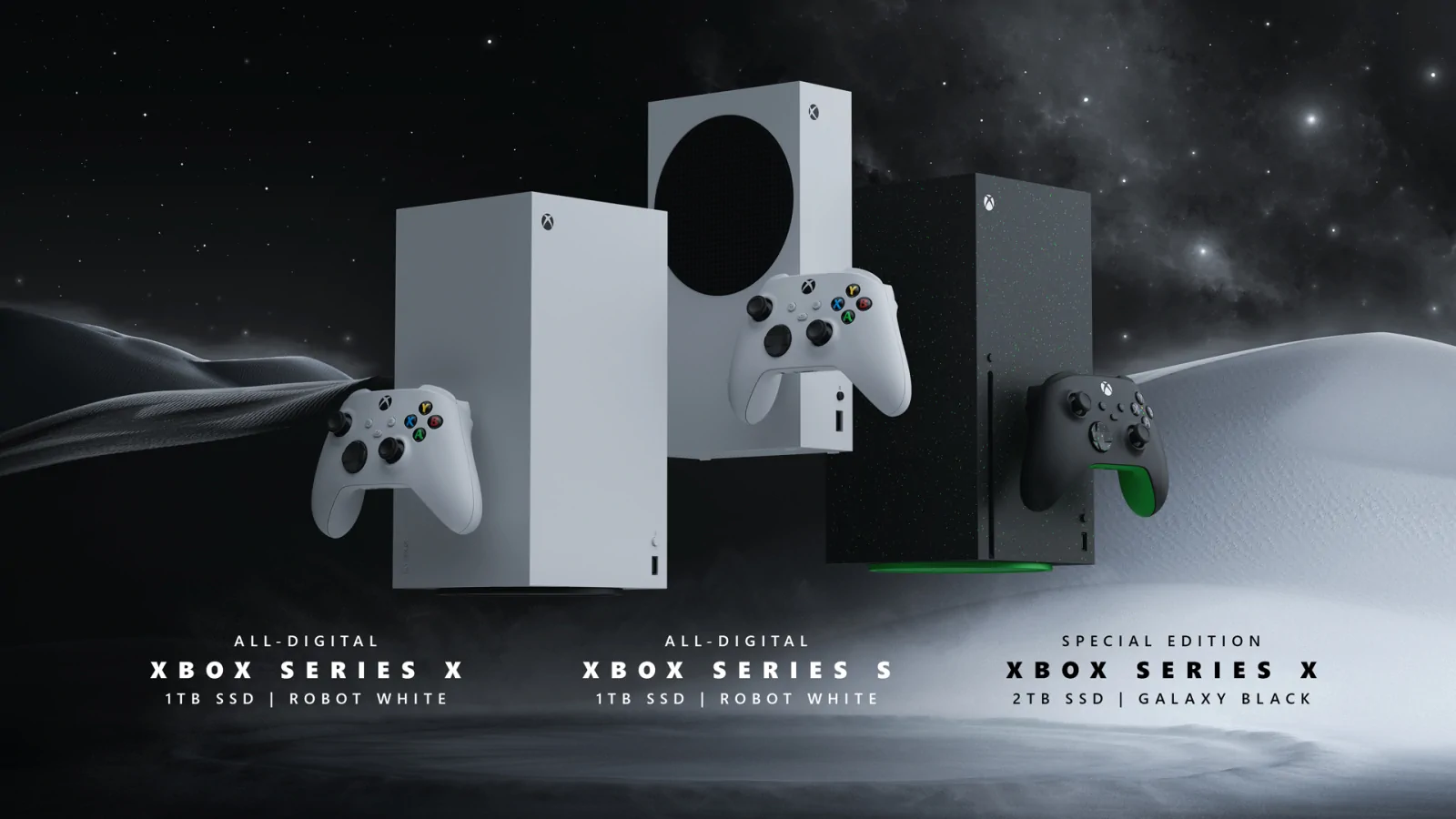
Knowing that Xbox Series X and Series S rely on RDNA 2 hardware without dedicated AI accelerators, the obvious question becomes: how could these consoles possibly run a neural-network-based technology like FSR 4.1?
The short answer is yes, they probably can.
But there are a lot of caveats.
The original AI model behind FSR 4 was initially designed around FP8 operations, a highly efficient low-precision format optimized for AI workloads. FP8 fits especially well with RDNA 4 and newer GPU architectures built specifically with AI acceleration in mind.
The problem is that neither RDNA 2 nor RDNA 3 were originally designed around FP8 execution.
To maintain compatibility with older hardware, AMD reportedly had to adapt the FSR 4.1 neural network to run using INT8 operations instead. INT8 is less advanced than FP8, but it’s far more compatible with existing GPU architectures.

And this is where one of RDNA 2’s most important hidden features comes into play: DP4a instructions.
While Xbox Series X and Series S lack dedicated AI hardware like Nvidia’s Tensor Cores or RDNA 3’s AI Accelerators, their shaders still support packed DP4a operations, which can accelerate INT8 calculations using standard shader hardware.
The concept behind DP4a is fairly straightforward. A shader can group multiple INT8 operations together and execute them simultaneously within a single clock cycle. It’s not true dedicated AI hardware, but it’s still a relatively efficient way to run neural inference workloads through traditional Compute Shaders.
In other words, current Xbox consoles do technically have the capability to execute at least part of the workload required by FSR 4.1.
The real issue isn’t compatibility.
The real issue is performance overhead.
Without separate dedicated hardware, the console GPU has to split resources between traditional game rendering and AI reconstruction tasks. Every neural network calculation consumes shader time that would otherwise be used for lighting, geometry, shadows, textures, and visual effects.
That additional workload is what’s commonly referred to as overhead.
And that’s the biggest unanswered question surrounding FSR 4.1 on consoles: whether Xbox Series X and especially Xbox Series S actually have enough performance headroom to run AI upscaling without the cost outweighing the visual gains the technology promises.
Can Xbox Series X and Series S Run FSR 4.1 Without Problems?
Now we get to the question that actually matters: being technically compatible with FSR 4.1 is one thing, but running it without seriously hurting performance is something else entirely.
Because yes, AI comes with a cost.
With neural reconstruction technologies like FSR 4.1, the performance impact depends heavily on output resolution and the complexity of the AI model itself. Reconstructing an image up to 1440p or 4K means continuously running inference operations on every frame, and that consumes GPU time even if the game is already rendering internally at a much lower resolution.
Current estimates place FSR 4.1’s overhead somewhere around 0.4 to 0.6 ms per frame under certain workloads. That might not sound like much, but on a console where every millisecond matters to maintain stable 60 FPS gameplay, that “AI tax” can make a huge difference depending on the hardware available.
Xbox Series X: There’s Actually Enough Headroom Here
For Xbox Series X, the situation looks fairly promising.
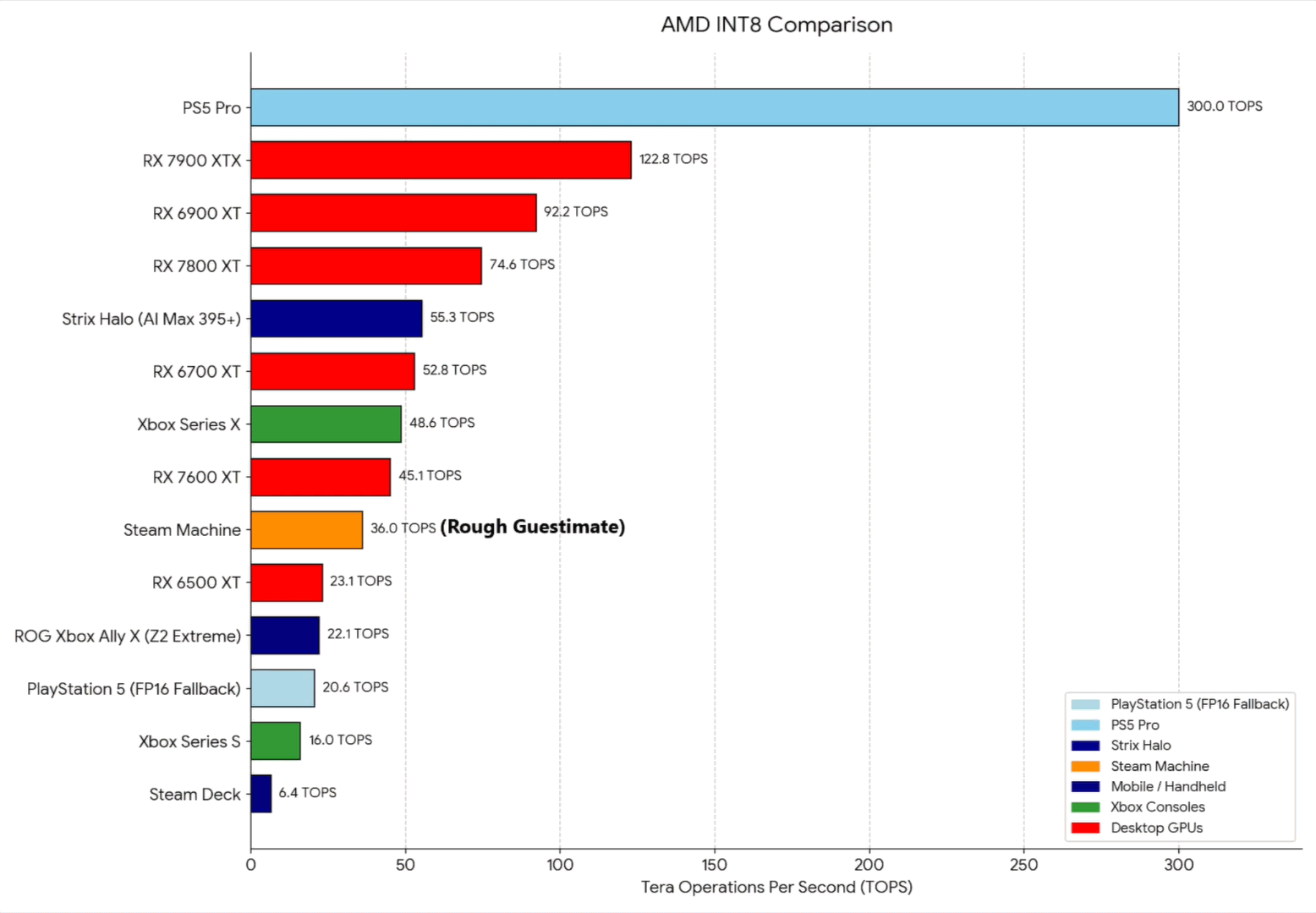
The console features a 52 CU RDNA 2 GPU with an estimated INT8 throughput close to 48.6 TOPS using DP4a instructions. Even without dedicated AI accelerators like RDNA 3 or RDNA 4, there’s still enough raw compute power available to absorb a significant portion of the neural workload without completely overwhelming traditional rendering.
In a demanding game like Resident Evil Requiem, for example, pairing a 1080p internal resolution with FSR 4.1 could be entirely realistic. The AI workload would consume roughly 8% to 10% of the GPU’s total INT8 compute budget, which is relatively manageable for a chip the size of Series X.
That would allow the console to maintain 60 FPS targets while delivering a much cleaner reconstruction than FSR 3.1, especially in problematic areas like foliage, transparencies, thin geometry, and fine moving detail.
In other words, Xbox Series X appears to have enough headroom to genuinely benefit from FSR 4.1.
Xbox Series S: This Is Where Things Get Much Harder
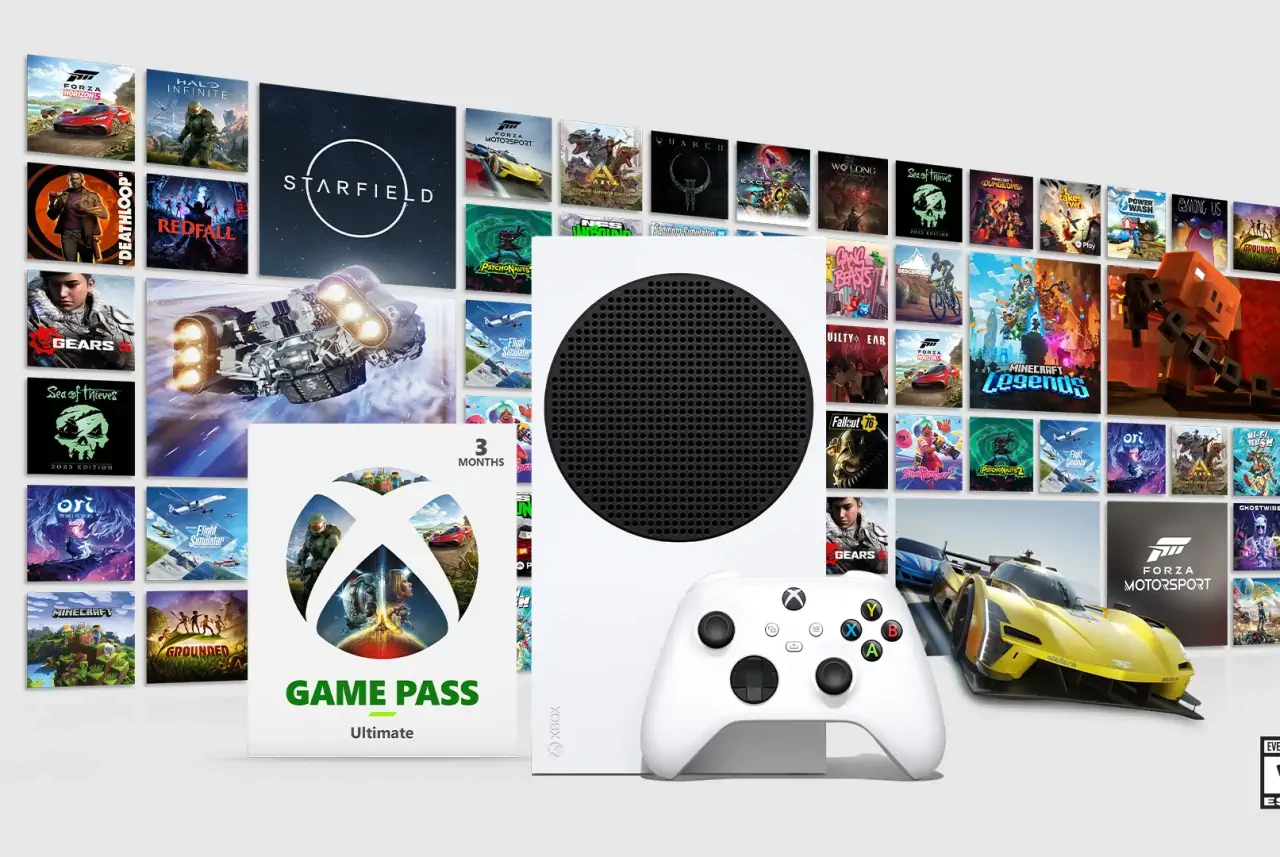
The situation changes dramatically once we move to Xbox Series S.
The console uses a heavily cut-down GPU with only 20 CUs and an estimated INT8 throughput of around 16 TOPS. On paper, it still supports DP4a and INT8 operations, but the amount of available headroom for AI workloads is drastically smaller.
And that’s the real problem.
If FSR 4.1 requires roughly the same neural compute workload as it does on Series X, the relative cost inside the GPU skyrockets. In some scenarios, AI reconstruction could consume close to 25% of the console’s total available compute budget.
That’s enormous for a system this constrained.
In practice, dedicating that much GPU time to AI means directly taking resources away from the game itself. Less budget for shadows, geometry, lighting, and rendering effects. The most likely result would be a noticeable performance drop, especially in games that are already pushing the hardware to its limits.
Then there’s the other major bottleneck: memory.
Xbox Series S only includes 10 GB of GDDR6 memory, and that’s already becoming a serious limitation for modern engines like Unreal Engine 5. Many recent games are aggressively reducing texture quality, caches, and internal buffers simply to stay within memory limits.
And when high-quality source data isn’t available in memory, AI can’t perform miracles. FSR 4.1 may reconstruct detail better than FSR 3.1, but it still can’t invent full-resolution textures that simply don’t exist inside the original framebuffer.
That’s why the Series S issue isn’t just about raw compute power. It’s also about memory bandwidth and available RAM.
To make the differences clearer, here’s how both consoles stack up against an AI workload like FSR 4.1:
| Technical Metric | Xbox Series X | Xbox Series S |
|---|---|---|
| Compute Units (CUs) | 52 CUs | 20 CUs |
| FP32 Performance | 12.15 TFLOPS | 4 TFLOPS |
| Estimated AI Throughput (INT8) | ~48.6 TOPS | ~16 TOPS |
| System Memory | 16 GB GDDR6 | 10 GB GDDR6 |
| Estimated FSR 4.1 Overhead | Low to moderate | Very high |
| 1440p / 60 FPS Viability | High | Extremely limited |
Xbox Could Gain an Advantage Over PS5 Late in This Generation
Interestingly, FSR 4.1 could also slightly shift the technical balance between Xbox Series X and PlayStation 5 during the later years of this console generation.
And not necessarily because of raw hardware power.
According to Moore’s Law Is Dead, one of Microsoft’s biggest advantages may come from its SDK and developer tools. Microsoft has spent years integrating relatively up-to-date FSR support directly into the Xbox ecosystem, making implementation significantly easier for multiplatform developers.
In theory, bringing FSR 4.1 to Xbox could end up being a fairly straightforward process for many studios.
Sony, meanwhile, appears to be taking a very different approach.
PlayStation’s current strategy revolves around PSSR (PlayStation Spectral Super Resolution), Sony’s own proprietary AI reconstruction system designed specifically for PS5 Pro. The issue is that Sony’s focus has shifted heavily toward that platform, while the standard PS5 still relies on older versions of FSR in many games.
That could create a very interesting situation over the next few years: some multiplatform games may ultimately deliver more advanced image reconstruction on Xbox Series X than on the base PS5.
Not necessarily because Microsoft’s console is dramatically more powerful, but because its ecosystem may allow developers to adopt AMD’s newer technologies more quickly and with less effort.
Xbox’s Future Will Inevitably Depend on AI
FSR 4.1 makes one thing very clear: AI is no longer a feature reserved exclusively for high-end PC GPUs. Little by little, it’s becoming one of the key technologies extending the lifespan of current-generation consoles as well.
And in that context, Xbox Series X could actually be in a fairly strong position.
Its GPU still appears to have enough headroom to combine traditional rendering with neural reconstruction without suffering a catastrophic performance hit. If AMD manages to optimize FSR 4.1 properly for RDNA 2 hardware, Microsoft’s console could enjoy a surprisingly strong visual second wind during the final years of this generation.
Series S, however, faces a much tougher reality.
Between the cut-down GPU, the 10 GB memory limit, and the extremely tight AI performance budget, aggressively deploying FSR 4.1 could end up doing more harm than good. For the smaller Xbox, sticking with lighter technologies like FSR 3.1 may ultimately make far more sense, prioritizing stability and frame rate over advanced neural reconstruction.
Because at the end of the day, no matter how impressive AI becomes, no technology can completely overcome the physical limits of the hardware underneath it.